
Where Are Sweaters Made in China? A Guide to Knitwear Manufacturing Hubs
 Views: 0
Quick answer
Sweaters in China are made in a small number of dense production clusters rather than spread evenly across the country — Guangdong around Dongguan and Dalang, Zhejiang around Puyuan and Tongxiang, plus Jiangsu, Shandong, Dalian and Fujian. Each tends to specialise in particular yarn types, gauges and order profiles, so the useful question is not which hub is best but which hub matches your product, quantity and price point.
"Made in China" tells you very little about where your sweater was actually knitted. Knitwear is a cluster industry: yarn spinners, flat-knitting mills, linking and finishing workshops and accessory suppliers sit within a short drive of each other, and that geography shapes what each region is good at.
Why is knitwear manufacturing so clustered?
A sweater is not assembled from parts shipped in from everywhere. The supply chain is short, heavy and interdependent, which rewards physical proximity.
- Yarn supply — local yarn markets and spinners let a mill buy small lots quickly and match dye lots on repeats.
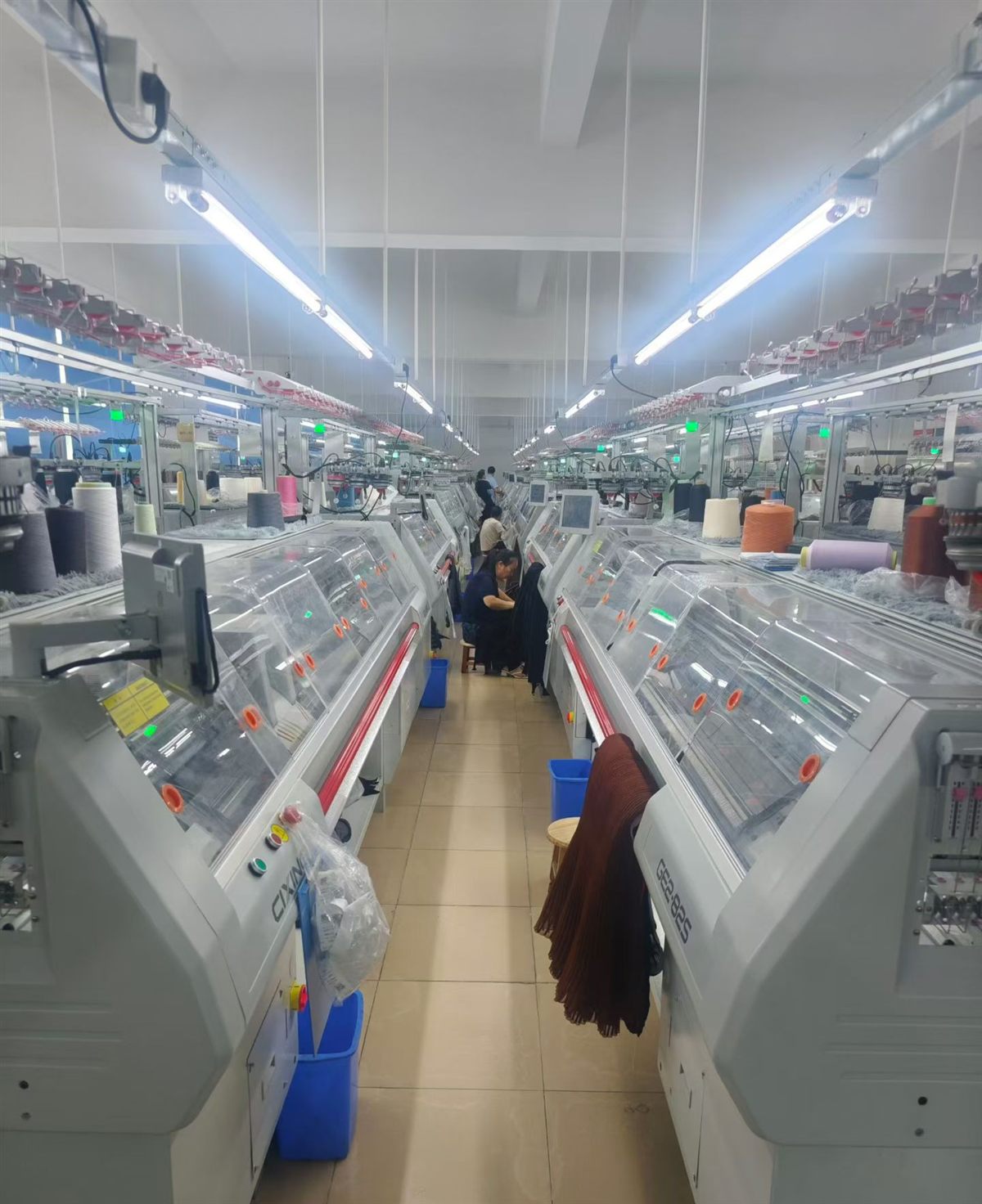
- Machine capacity — computerised flat knitting machines are expensive, so clusters support both large factories and small specialist workshops that absorb peaks.
- Finishing — linking, mending, washing and steam pressing are separate trades, served by dedicated workshops nearby.
- Trims and skills — buttons, labels and hangtags are available locally, and linking operators and knitting technicians are trained inside the cluster.
The practical effect is speed: a style amendment that takes weeks in an isolated factory can sometimes be handled in days inside a mature cluster.
Which knitwear clusters matter, and what does each do best?
These are general regional tendencies, not rankings. Individual factories differ widely, and strong suppliers exist in every hub.
Guangdong: Dongguan, Dalang and the Pearl River Delta
Dongguan and the neighbouring Dalang area are generally known for sweater production and are typically associated with mid-to-high-end and fast-fashion programs. The region has mature computer flat-knitting capacity, an active yarn market and strong export experience through the Shenzhen and Guangzhou ports. YZR Sweaters is based here.
Zhejiang: Puyuan, Tongxiang and the wider Yangtze Delta
Puyuan in Tongxiang is one of China's largest sweater production and trading bases, often associated with very large volumes, rapid style turnover and a deep wholesale market. Trend-driven, high-volume programs refreshed frequently tend to find this cluster competitive. Hangzhou and Ningbo are more typically associated with brand supply chains, where design support and compliance documentation matter more than volume.
Other established regions
- Jiangsu and Shandong — generally associated with woollen and worsted knitwear and with established export programs for colder-season styles and wool-rich blends.
- Dalian, Liaoning — long linked to knitwear production serving Japan and South Korea, so factories there typically carry experience with the stricter finishing standards those markets expect.
- Fujian and the Shantou area — typically associated with knit and woven combinations, jersey-based products and lighter knit categories.
How does the hub affect price, lead time and product fit?
Two factories quoting the same style from different clusters are not quoting the same cost base. Labour and overhead vary by region, and finishing trades may cost more or less depending on local supply. A hub near a spinning base can buy wool or cashmere blends cheaper and faster than one importing yarn. Machine mix matters too: a cluster built around chunky gauge machines is an awkward fit for fine-gauge work. High-volume clusters optimise for large runs with short cycles, while others take smaller, more technical orders. Distance to port adds inland trucking days, which bites harder in peak season.
What should you ask before choosing a region?
- Do you knit on your own machines, and how many gauges can you run?
- Which finishing steps are in-house and which are subcontracted?
- Where do you buy yarn, and can you match a specific count and dye lot?
- Which product categories and export markets do you normally work in?
- What is your realistic capacity in our delivery window?
These five answers tell you more about fit than a regional reputation does.
Is a famous hub the same as a good factory?
No. Cluster reputation is a proxy for infrastructure, not for any individual supplier. A well-known production town contains excellent factories and weak ones side by side, and the address on a business licence proves nothing about machine condition, quality control or labour practice. Verify the factory you will actually use: review its audit reports, ask to see the knitting floor, and check that finishing is controlled rather than subcontracted invisibly. Our partner factories hold BSCI, SEDEX and Oeko-Tex certification, welcome audits and accept third-party inspection by SGS or BV. The supplier vetting checklist lists the documents worth requesting.
Should you visit the factory in person?
For a first order, a live video walkthrough of the knitting floor, linking area and finishing line is usually enough. For larger or multi-season programs, an in-person visit pays for itself: you can see the machine park and confirm capacity claims directly. If travel is impractical, commission an audit or pre-shipment inspection instead. Our notes on planning a knitwear sourcing trip cover what to see.
Sourcing knitwear from China and unsure which hub fits your program? Send us your style, yarn direction and target quantity — we'll reply with a quote, suggested production route and sampling plan within one business day.
Get a free quote Visit yzrsweaters.comFrequently asked questions
Is Dongguan more expensive than other Chinese knitwear regions?
Cost differences exist but they are not decisive on their own. Pearl River Delta wage and overhead levels are typically higher than in inland clusters, which can show up in unit price on simple styles. On programs that need flexible development, tighter deadlines or higher finishing standards, buyers often find the region competitive once sampling cycles and rework are counted.
Can one factory handle both chunky and fine-gauge sweaters?
Some can, but many specialise by gauge because the machine park and the operator skills differ. A mill running 3GG and 5GG chunky machines is not automatically set up for 14GG fine-gauge work, even if it quotes both. Ask which gauges the factory runs on its own machines in volume before assuming a single supplier can cover your whole range.
Do I need a Chinese trading company to work with a regional factory?
Not necessarily. Many export-oriented knitwear manufacturers handle documentation, inspection and shipping directly, while others work through established trading partners. What matters is who carries responsibility for quality, timelines and compliance, and whether you have direct access to production information. Our comparison of trading companies versus factories explains the practical differences.
Comments
Comments are loading. To enable live comments, see setup notes in the repo.