
Flat Knitting vs Circular Knitting: Machine Types Behind Your Sweaters
 Views: 0
Every sweater was made on a knitting machine, but not all knitting machines make sweaters. The choice between flat knitting and circular knitting decides what a factory can produce, what a style costs, and how a garment behaves after washing.
Two ways to form a knitted fabric
Flat knitting builds fabric in rows that go back and forth on a straight needle bed, so the piece comes off as a flat panel with a defined width. Circular knitting builds fabric in a continuous spiral on a cylinder of needles, producing a tube that is later cut and sewn. That single mechanical difference — flat bed versus cylinder — explains the product categories, the shaping possibilities, the waste and the price.
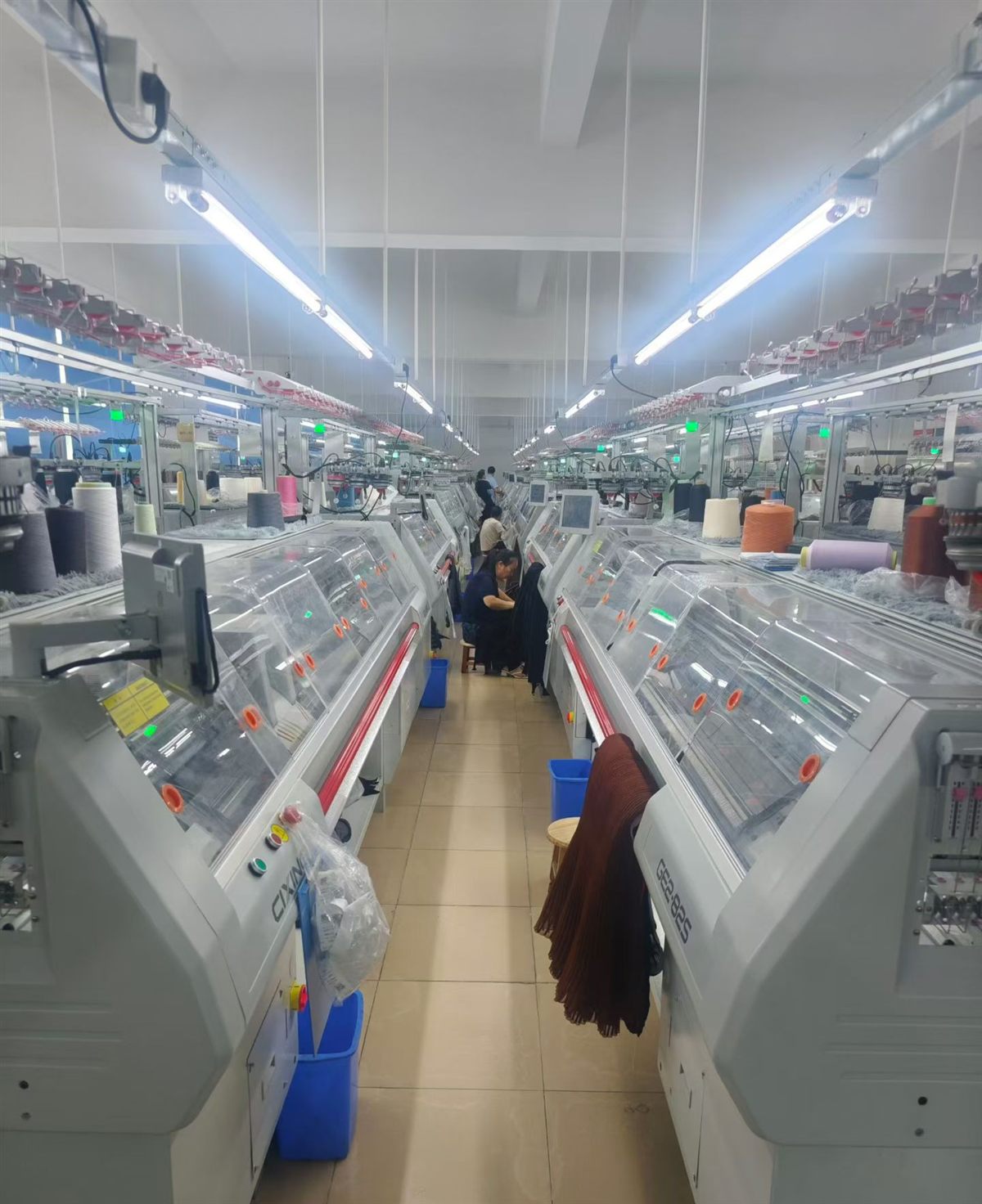
Computerized flat knitting: the sweater workhorse
A computerized flat knitting machine uses individual needle selection, so any needle can be programmed to knit, tuck, miss or transfer on any row. That freedom is what allows jacquard, cables, ribs, pointelle and intarsia to be knitted into the panel rather than embroidered or printed afterwards.
- Shaping on the machine. Panels can be knitted to their final outline — fully fashioned — so the garment is shaped rather than cut.
- Stitch variety. Cables, jacquard, intarsia, tuck textures and openwork are all achievable within the machine's programming.
- Gauge and repeatability. Machines are built for a gauge range, from chunky 3GG through 7GG and 12GG to fine 16GG, and once programmed every panel matches the last.
The trade-off is speed: a flat machine knits deliberately, so machine time rather than labour is usually the capacity constraint.
Hand flat machines: small runs and chunky yarns
A hand flat machine is a manual version of the same bed, with the carriage moved by hand and a chart followed. Being manually driven, it handles very thick yarns and short runs that would not justify programming a computerized machine. Output per operator is much lower, but MOQ is often lower too, since setup is a chart rather than a programme. Unit cost tends to be higher on volume — which is why hand flats suit chunky statement knits and development work.
Circular knitting: fabric, not shaped garments
Circular knitting produces a tube of fabric at speed: the machine runs continuously, and the tube is cut to pattern and sewn. This places it in the cut-and-sew family rather than in sweater shaping.
- Where it fits: jersey T-shirts, polo bodies, base layers, sweatshirt fabric and simple knit tops.
- Speed and cost: high output per machine hour, which generally makes it the cheapest way to knit a garment in volume.
- MOQ: usually driven by yarn and dyeing rather than machine setup, so it can be flexible — but a fabric minimum applies.
- Limits for sweaters: the garment is cut from flat fabric, so it lacks the shaped, elastic hand feel of a knitted panel.
Some circular machines make sweater-weight fabric for lower-priced "knit-look" garments, where the hand feel and shape retention are different.
Why sweaters are usually flat knitted
- Shaping. A sweater needs a shaped neckline, armhole and shoulder; flat knitting builds these into the panel.
- Texture. Cables, ribs and jacquard are stitch structures, not prints — they only exist if the machine selects needles individually.
- Elasticity and recovery. A flat-knitted panel holds its shape and springs back better than one cut from circular fabric.
The distinction is not quality, it is fitness for the design: a fine-gauge cotton T-shirt in volume is often better value built from circular fabric.
What this means for MOQ, cost and lead time
- Programme setup. A new flat-knit style needs a programme, a knit-off and a fit sample, so development cost sits in the first order.
- MOQ. Usually set per style and colour, and partly by yarn minimums at the mill, so a new colour tends to raise the practical minimum.
- Gauge availability. Not every factory holds every gauge, so a chunky and a fine-gauge range may not run on the same floor.
- Capacity booking. Autumn/winter capacity fills early, and fine-gauge cotton programmes cluster in spring.
How to discuss machinery with a supplier
- Ask which gauge the style will run on, and whether that matches your target weight and hand feel.
- Send the reference garment and ask the factory to identify how it was built before quoting.
- Ask what the machine can and cannot do for your design — panel shaping, jacquard repeats, cable width, intarsia.
- Confirm how seams are joined and request a knit-off before bulk on any new stitch or yarn.
How machine capability limits your patterns
A jacquard repeat has to fit the needle width available, cables need enough needles across the panel, and colour count in a jacquard row is limited by the number of yarn carriers. Very chunky yarns may exceed what a fine-gauge bed can feed, while a 3GG machine cannot deliver the tight surface of a 16GG knit. The same sketch can be cheap on one machine and impossible on another.
Where YZR Sweaters fits
YZR Sweaters is a Dongguan knitwear manufacturer producing custom sweaters, cardigans, knitted polos, dresses, scarves and hats on an OEM/ODM basis. Our partner factories run computerized flat knitting machines across a range of gauges, and we advise buyers on the right construction during development rather than after the quote. They hold BSCI, SEDEX and Oeko-Tex certification and welcome factory audits and third-party inspection such as SGS or BV, so you can verify the equipment and working conditions behind your order.
Sending a tech pack or a reference sweater? Share the stitch detail, target weight and quantity and we'll recommend the machine and gauge, then come back with a sampling plan and quote.
Get a free quote Visit yzrsweaters.com
Comments
Comments are loading. To enable live comments, see setup notes in the repo.