
Knitted Dresses: A Complete Buying Guide for Retailers
Quick answer
A knitted dress is a complete outfit with a higher ticket than a sweater, but it exposes every construction weakness. Agree four things before sampling: rib direction and density, since a tight 2x2 or 1x1 rib holds shape while a loose one stretches at the hip; stretch recovery on a washed sample; opacity checked against light in the lightest colourway; and neckline or strap stability. Grade from a dress block rather than a sweater chart, and publish finished garment measurements.
A knitted dress does more per unit than almost any other knitwear style. It is a complete outfit, it carries a higher ticket price than a sweater, and it photographs well enough to sell online without a model swap. It is also less forgiving: fit, opacity and recovery decide whether it becomes a repeat order or a return-rate problem.
The main knit dress shapes
- Bodycon and fitted rib — a fine or mid rib that follows the body; strong seller in autumn/winter and party capsules.
- Straight and shift — a relaxed column shape, easier to fit across a wider size range.
- Sweater dress with a defined waist — belted or seamed, often in a heavier gauge; reads premium.
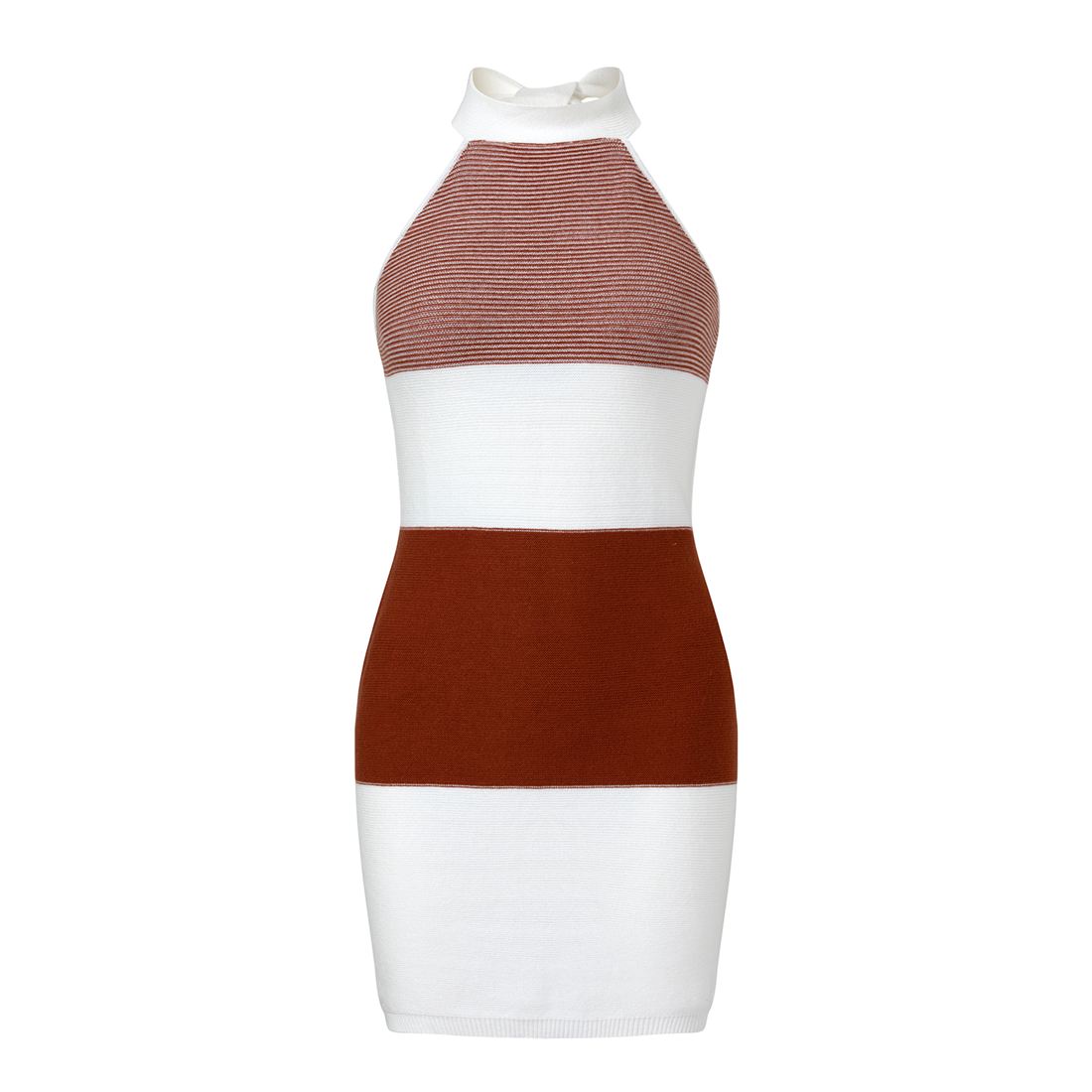
- Halter and sleeveless knit dresses — resort and warm-weather lines, usually a lighter yarn.
- Knit two-piece sets — matching dress and cardigan or top; a strong bundle for e-commerce.
- Longline and maxi knits — heavier yarns, more yarn consumption, higher shipping weight.
- Fit-and-flare and A-line — more panels and shaping, more sample rounds to get right.
Construction points buyers should control
Knits behave differently from woven fabric, and a dress exposes every weakness in the construction. The four things to agree with your supplier before sampling:
- Rib direction and density — a 2x2 or 1x1 rib with tight density holds shape; a loose rib stretches out at the hip and seat.
- Recovery and stretch — the dress must return to size after wearing. Ask for an elastane or stretch-blend yarn where the fit is close, and check recovery on a washed sample.
- Opacity — check the knit against a light source in the lightest colourway of the range. Lining, a denser gauge or a slightly heavier yarn are the usual fixes.
- Neckline and strap stability — halter ties, straps and open necklines need reinforcement or they distort in wear and washing.
Seams and linking matter more on a dress than on a sweater because the garment is under tension over a longer length. Ask how armholes and side seams are finished, and inspect them on the pre-production sample rather than at bulk.
Season and weight
Knit dresses split into two clear programs, and confusing them is an expensive mistake.
- Autumn/winter — heavier gauges, wool and wool-blend yarns, turtleneck and long-sleeve shapes, darker colour ranges.
- Spring/summer — fine-gauge cotton, viscose and blends, sleeveless and halter shapes, lighter and more transparent colourways.
- Resort and party capsules — often the same shape as core but in a metallic, lurex or textured yarn.
The weight you choose drives yarn consumption, and yarn consumption drives cost more than any other variable. A heavier knit dress uses noticeably more yarn than a sweater in the same gauge, so quote the dress as its own line, not as a scaled-up sweater.
Sizing and return risk
Dresses are the highest return-risk category in most online knitwear ranges, mainly for fit. Reduce the risk before it reaches the customer:
- Fit the sample on real bodies across your size range, not on a base size alone.
- Confirm how the grade rule changes with length — a dress graded straight from a sweater chart usually misses at the hip.
- Publish finished measurements, not just body measurements, so customers can compare against a dress they own.
- Repeat the same block across styles where you can; a proven fit is worth more than a new one.
Selling knit dresses together
Knit dresses bundle well. A matching cardigan or a fine-knit top lifts the average order value without new photography, and a two-piece set can be sold as one unit or split into two SKUs depending on how your channel performs. Colour is the cheapest way to widen a dress range: three colourways of one proven shape usually outsell three unproven shapes.
Choosing a knit dress supplier
Look for a supplier who can knit the dress shape, not just the sweater shape — that means experience with long panels, dress blocks and the recovery behaviour of stretch yarns. Our OEM/ODM service covers knitted dresses, two-piece sets and matching accessories, with custom colours, private label trims and packaging. MOQ is flexible for first runs, sampling is straightforward, and our partner factories are certified (BSCI / SEDEX / Oeko-Tex) and welcome audits and third-party inspection.
Sourcing knitted dresses? Send us your style references, colours and target quantity — we'll reply with a quote and sampling plan within one business day.
Get a free quote Visit yzrsweaters.comFrequently asked questions
How can I check whether a knit dress is see-through?
Check the knit against a light source in the lightest colourway of the range, because that is where transparency shows first. If it fails, the usual fixes are a lining, a denser gauge or a slightly heavier yarn. Testing the palest colour matters because darker colourways can hide a problem the customer will see in the lightest one.
Can a knit dress be graded from a sweater size chart?
Not reliably. A dress graded straight from a sweater chart usually misses at the hip, because the grade rule has to change with the extra length. Confirm with your supplier how the grade rule changes down the dress, and fit the sample on real bodies across your size range rather than on a base size alone.
Which rib structure holds a knit dress in shape?
A 2x2 or 1x1 rib with tight density holds shape, while a loose rib stretches out at the hip and seat. Where the fit is close, ask for an elastane or stretch-blend yarn and check recovery on a washed sample, so the dress still returns to size after wearing.