
Carbon Footprint for Knitwear: What Buyers Can Actually Measure
Quick answer
A sweater's carbon footprint is dominated by the yarn, not by the knitting — fibre production, spinning and dyeing account for the large majority of the total, while knitting, making up and freight are comparatively small. That distribution matters, because it means a factory can only directly answer for a minority of the figure. Realistic reporting starts with fibre weight per garment and fibre type, uses published emission factors for the yarn, and treats factory-level energy data as a refinement rather than the foundation.
Carbon reporting has moved from a voluntary marketing exercise to a request that arrives attached to supplier questionnaires, retailer scorecards and increasingly to procurement terms. For a knitwear buyer the difficulty is not the concept but the arithmetic: the emissions sit mostly in the yarn, the yarn is supplied by a spinner, and the data needed to calculate them precisely is not usually available at the garment factory. That is a manageable problem, as long as the reporting is honest about what it covers.
Where do a sweater's emissions actually come from?
The distribution is uneven, and knowing the shape of it prevents wasted effort. In rough order of contribution:
- Fibre production. Growing or producing the raw fibre, whether that is wool from a farm, cotton from a field, or polymer for a synthetic. This is usually the single largest block, and it varies enormously by fibre — which is why fibre choice moves the total more than any production decision.
- Spinning and yarn preparation. The conversion of fibre into yarn, including scouring, carding or combing, spinning and plying. Our notes on ply and twist explain why a more heavily processed yarn carries more of this.
- Dyeing and finishing. Dyeing is energy- and water-intensive, and the route matters. Our notes on yarn-dyed and piece-dyed routes cover how the choice changes the process, and garment dyeing and finishing covers what the finishing stages add.
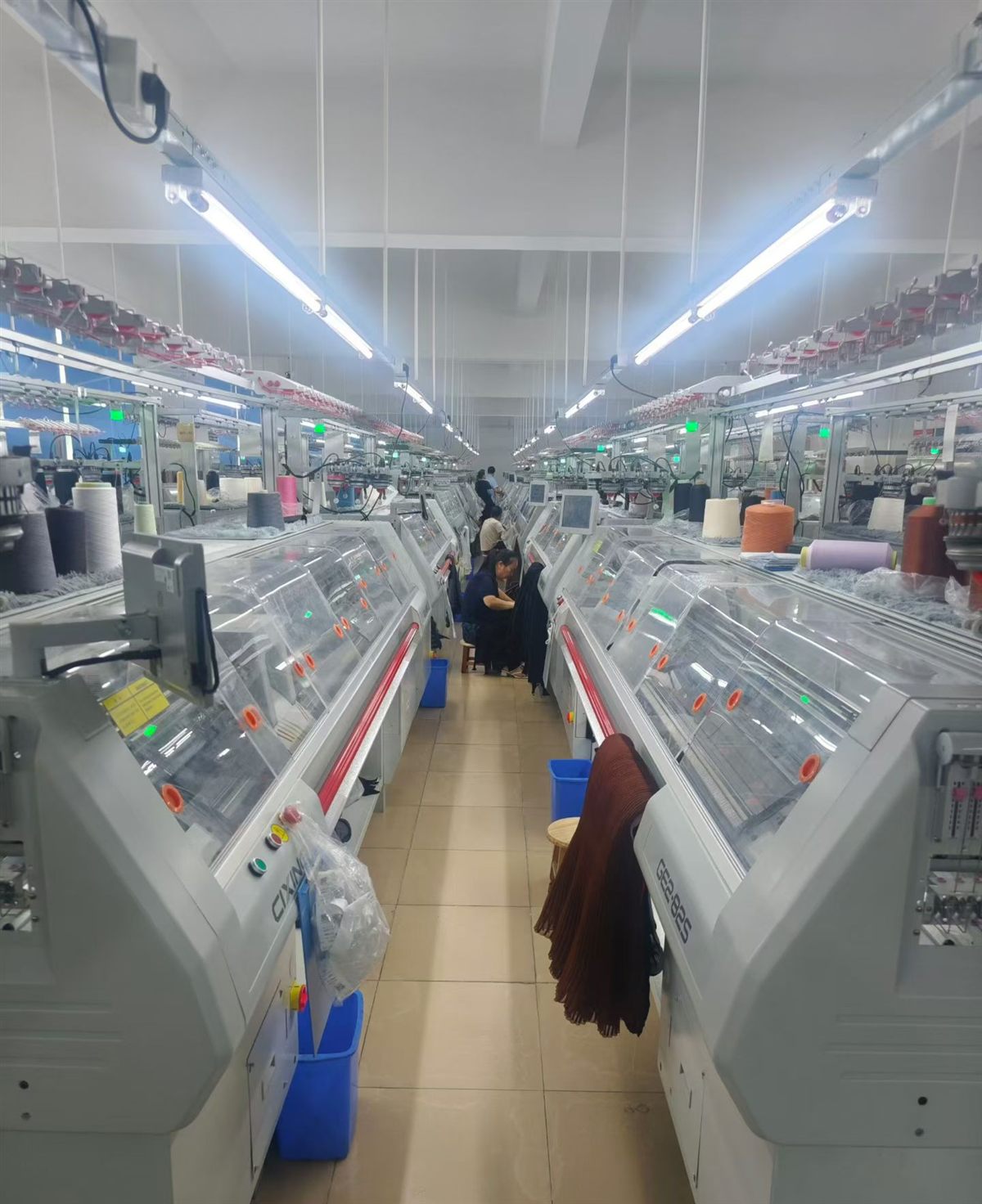
- Knitting and making up. The flat-bed knitting, linking and assembly — real energy use, but modest against the fibre.
- Transport. Moving yarn to the factory and finished goods to the customer. Sea freight is usually a small fraction of the total for a sweater.
- Use and end of life. Washing and drying over the garment's life, plus disposal. Frequently outside the scope the buyer is asked to report, but it can be substantial and it is where care labelling has its climate consequence. Our notes on microfibre shedding cover the related washing-impact question.
The headline for a buyer is that fibre choice dominates. Shifting a programme from a virgin synthetic to a recycled one, or from a conventional fibre to a certified lower-impact equivalent, moves the total more than any factory-side efficiency measure available in the short term.
Which data can a knitting factory actually provide?
Being clear about this prevents both over-asking and over-claiming. A knitting factory in Dongguan can genuinely supply:
- Yarn consumption per garment, by weight and by fibre. This is the single most important input and the factory knows it precisely, because it is how the garment is costed. Our notes on yarn consumption explain how the figure is derived.
- Fibre composition of the yarn used, and who spun it. This allows the buyer to apply published emission factors for that fibre type.
- Factory energy data, if the buyer asks for it specifically — total electricity and fuel consumption over a period, and sometimes the metered share attributable to a production line. Many factories can provide this at site level; few can allocate it to a single order accurately.
- Production process information — the dyeing and finishing routes used, and any washing or treatment steps, which the buyer needs to model those stages.
- Freight information, including mode, route and container utilisation, which matters more than buyers expect because a half-filled container carries a double emissions penalty per garment. Our notes on sea freight cover packing efficiency.
What the factory cannot supply, as a rule, is primary emission data for the fibre itself. That sits with the farm, the fibre producer or the spinner, and it arrives as a certificate, a declaration or a published factor rather than as a measurement. Our notes on welfare and traceable wool describe the same chain-of-custody reality from the fibre side.
How is the calculation actually done?
The practical method is activity multiplied by an emission factor. Take the weight of each fibre in the garment and multiply it by a published emission factor for that fibre, then add the conversion stages — spinning, dyeing, knitting, transport — using either the factory's own energy data or published factors for those processes too.
System boundaries then decide what the number means. A figure covering fibre to factory gate is a different quantity from one covering fibre to customer, and a different one again from cradle-to-grave including washing. Most supplier questionnaires want cradle-to-gate with transport, but it is worth reading the question rather than assuming — reporting the wrong boundary is a common and avoidable error.
Why does the factor choice matter so much?
Because factor choice changes the answer more than measurement does. Different databases give different values for the same fibre, because they assume different geographies, energy mixes and system boundaries. A result quoted to two decimal places implies a precision that the underlying factors do not support.
The practical consequence is that a footprint figure should always be presented with the method and the factors named. A number with a stated source can be checked, defended and compared with a previous season's; an unexplained number cannot, and will not survive a retailer's review. Our notes on EU sustainability rules cover the direction of travel on substantiating environmental claims.
What should a buyer do in practice?
- Start with yarn weight and fibre type. Those two inputs get you most of the way, and both come from the factory on request as part of the normal costing conversation.
- Use recognised published factors and name them. A figure with a stated source and method is defensible; an unexplained one is not.
- Ask the factory for what it can genuinely give. Yarn consumption, fibre composition, process routes, packing efficiency and site energy data — not a farm-level figure it does not hold.
- Do not quote a precision the data does not support. Whole-number percentages and clear boundary statements are more credible than a figure to three decimal places built on estimated factors.
- Look at where the levers are. If the goal is a lower footprint rather than a reported number, the decisions that move it are fibre choice, yarn weight, dyeing route and container fill — not factory lighting.
- Keep the record with the order. The buyer who can reproduce the calculation in a review is in a stronger position than one who has to start again.
At YZR Sweaters we work with partner factories holding BSCI, SEDEX and Oeko-Tex certifications, welcome factory audits, and support third-party inspection through firms such as SGS and BV. On emissions data we supply what we actually hold — yarn weight per garment, fibre composition, process routes, packing detail and site energy consumption — and we say plainly where the fibre-level figures have to come from the spinner or a published source rather than from us. A footprint built on accurate inputs and honest boundaries is worth more than a precise-looking number nobody can reproduce.
Filling in a carbon questionnaire or setting a footprint target for a knitwear range? Send us the styles and the reporting boundary you need, and we will come back with the data we can supply.
Get a free quote Visit yzrsweaters.comFrequently asked questions
Does the knitting factory or the fibre producer cause most of a sweater's emissions?
The fibre, by a wide margin. Fibre production, spinning and dyeing together account for the large majority of a sweater's footprint, while knitting, making up and sea freight are comparatively small. That is why fibre choice and yarn weight move the total far more than factory-side efficiency measures.
Can I get an accurate carbon figure for a single sweater?
You can get a defensible estimate, which is not the same thing. The calculation multiplies known weights by published emission factors, and the factors themselves vary between databases, so the result carries a real range of uncertainty. Always state the method, the factors and the system boundary alongside the number.
What is the single most useful data point to request from a supplier?
Yarn consumption per garment by fibre type. It is the largest determinant of the footprint, the factory knows it precisely because it is how the garment is costed, and without it no meaningful calculation can be done at all.