
Selling Knitwear on Amazon and Shopify: A Product Selection Guide
 Views: 0
Selling knitwear online is a different business from selling it wholesale. The buyer can't touch the yarn, can't try the fit, and decides in a few seconds from a thumbnail. That changes which styles are worth stocking, how you plan sizes, and how much you should commit to a first order. Here is how to think about product selection before you approach a factory.
Start from the channel, not the product
Amazon and Shopify reward different things. Amazon rewards keywords, reviews and conversion history — the listing that ranks usually has the cleanest title, the strongest main image and consistent reviews. Shopify rewards brand story and repeat purchase. A plain crewneck may be the perfect Amazon item and a mediocre Shopify item; a distinctive, brand-led silhouette may be the reverse. Decide which channel is your priority before you design the range.
Basics versus differentiated styles
- Basics — crewnecks, plain cardigans, simple polos. High search volume, easy to advertise, but you compete on price and must maintain stock across many sizes.
- Differentiated styles — textured stitches, unusual colourways, distinctive trims. Less direct competition and better margin, but harder to explain in a thumbnail.
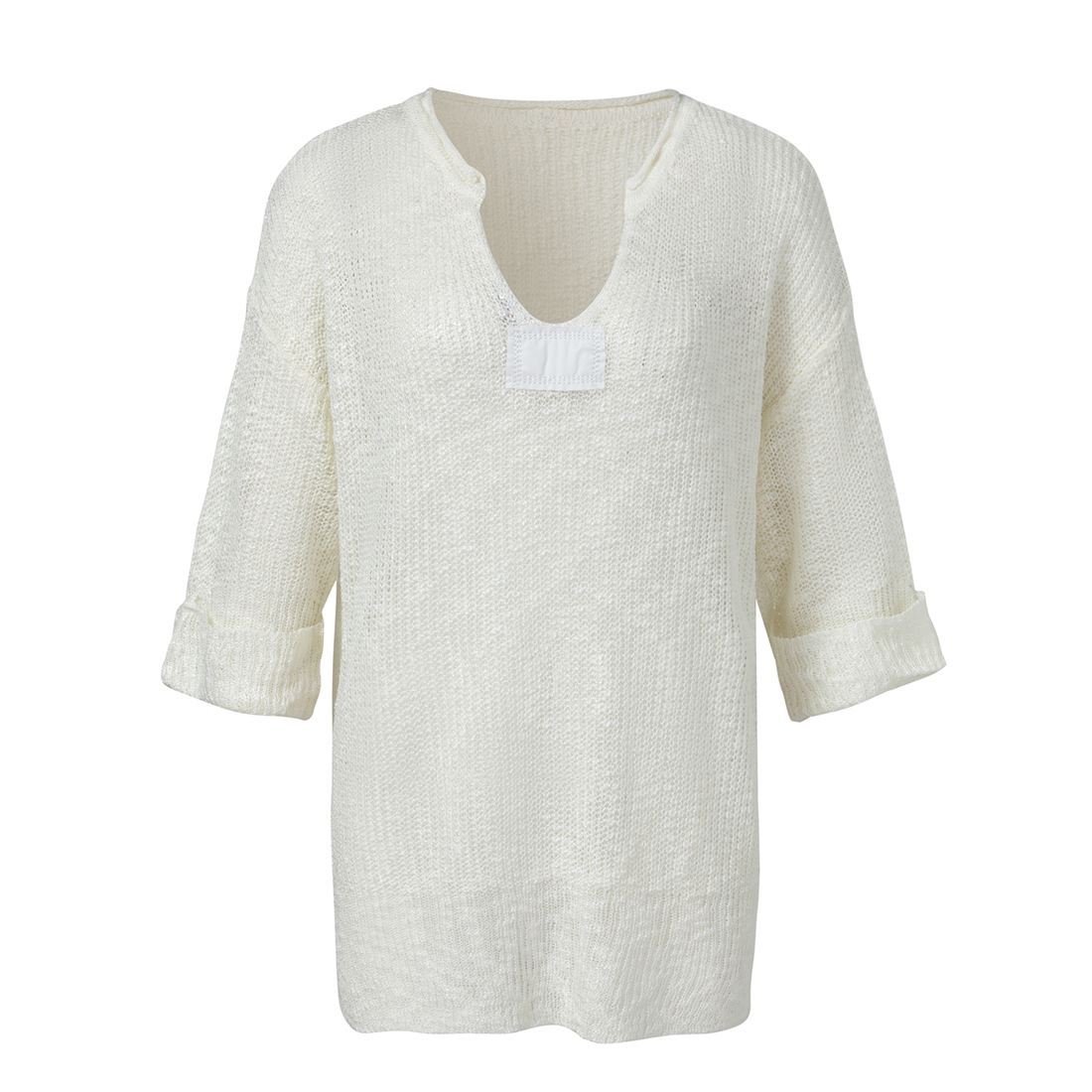
- The workable middle — a familiar silhouette in a detail that photographs well: a cable panel, a half-zip, a contrast collar, a slightly cropped or oversized line.
A small core of basics funded by two or three differentiated styles is usually more stable than an all-basics catalogue.
What makes a knitwear style good for ecommerce
- Photographs well flat or on a model — clear silhouette, structure that holds shape on a hanger, texture that reads at thumbnail size.
- Forgiving fit — relaxed, oversized or straight lines tolerate small sizing differences; sharply tailored knits expose every grading error.
- Few fit-critical decisions — a scarf, beanie or loose cardigan is far safer online than a fitted knit dress.
- Colour that survives screens — muted, mid-tone and melange shades photograph consistently; pale cream and deep black are hardest.
- Light and packable — fine-gauge knits lower shipping cost and storage footprint versus chunky sweaters.
Sizing is where online knitwear quietly loses money. Ask your supplier for a graded size set with measured specs, and state armhole, chest and length in your listing.
Packaging and private label
An unbranded sweater in a plain polybag is a commodity; the same sweater with your label is a product. The private label essentials are a woven main label, a printed care and content label, and branded packaging — a printed polybag, a paper band or a box. Hangtags add perceived value at low cost and photograph well. Plan your FNSKU labelling too: if you sell on Amazon, labels go on the unit and the outer carton, and your factory can be set up to handle that.
Content labels matter more online than in a shop, because the fibre and care information is often the only reassurance a customer gets.
MOQ, sampling and how to test styles
The classic mistake is committing to a large first order on a guess. Test small, read the data, then scale the winners.
- Sample first — one or two samples per style tells you more than a spec sheet.
- Test in a small batch — launch a limited run, keep the best-selling colourway, drop the rest.
- Re-order fast on winners — ask upfront what the lead time is for a repeat order in the same yarn, since the fibre and dye lot are the slow parts.
- Treat test quantity as marketing spend, not inventory.
MOQ depends on the yarn, the gauge and the number of colourways: a stock yarn in one colour is the cheapest thing to run, while a custom-dyed exclusive colour needs more units to be viable. Discuss MOQ per colourway rather than per style, and ask whether your manufacturer can hold a stock yarn so later batches match the first.
Seasonal timing
Knitwear sells on a narrow calendar, and online demand starts earlier than most first-time sellers expect. Search volume for sweaters climbs well before the weather turns, so listings need stock and reviews in place beforehand. Work backwards from your target selling window: allow time for sampling, bulk production, shipping and inbound receiving, then add a buffer.
Common pitfalls
- Size returns — caused by inconsistent grading or a vague size chart. Fix the spec, not the description.
- Photo-to-reality mismatch — over-edited imagery produces returns and poor reviews. Shoot in neutral light and show the texture close up.
- Stockouts on the best size — ranges sell unevenly, so order to a realistic size ratio rather than an even split.
- Colour drift between batches — a re-dyed lot never matches exactly; standardise on a stock yarn where consistency matters.
- Care complaints — knits that pill or shrink after one wash generate reviews you cannot recover from. Test-wash a sample first.
Building the supply side
YZR Sweaters supplies small-batch knitwear for online sellers as well as larger wholesale programs, from Dongguan in southern China. Our OEM/ODM service covers custom styles, colours, private label trims and retail packaging, and we can start with a test quantity before scaling into repeat production. Our partner factories are certified to BSCI, SEDEX and Oeko-Tex and welcome audits and third-party inspection, which matters if you sell on platforms that ask for supplier documentation. Send your style reference and target selling price — the yarn and gauge conversation follows from there.
Planning a knitwear range for Amazon or Shopify? Tell us your target styles, sizes and test quantity — we'll reply with a quote, MOQ per colourway and a sampling plan.
Get a free quote Visit yzrsweaters.com
Comments
Comments are loading. To enable live comments, see setup notes in the repo.