
Sourcing Knitwear on Alibaba: What the Listings Don't Tell You
Quick answer
Alibaba is a good shortlisting tool for knitwear suppliers and a useful benchmark for price and MOQ ranges — but the listing price is not your price, the badges verify existence more than quality, and the same photos appear on dozens of unrelated pages. Use it to build a shortlist of five to ten candidates, then move the conversation off the platform quickly: verify the factory, request real samples, and judge the quotation detail rather than the storefront polish.
"Can't I just find a sweater factory on Alibaba?" is usually the first question we hear from founders planning their first knitwear range. The honest answer is yes, you can — plenty of people do — and it's also where some of the most expensive beginner mistakes happen. This is what the marketplace is genuinely useful for, what the listing signals do and don't mean, and where it pays to go direct.
What Alibaba is genuinely good for
Three things, and they're worth using before you talk to anyone:
- Market discovery. In a couple of evenings you can map out who claims to make knitwear, from which province, at what claimed MOQ, and with what minimum style of business. That's a faster lay of the land than any other free tool.
- Price calibration. Listing prices for knitted garments cluster in recognizable bands by category and fibre. You won't get your real price — custom yarn, custom colours, smaller quantity — but you'll know when a later quote is wildly off the street.
- Response-time testing. How a supplier communicates during a low-stakes marketplace enquiry is a preview of how they'll communicate when your container is two weeks late. Fast, specific replies with real questions are a good sign; copy-paste brochures are not.
How to read a knitwear listing critically
Marketplace listings are marketing, and knitwear listings have specific habits you should discount for:
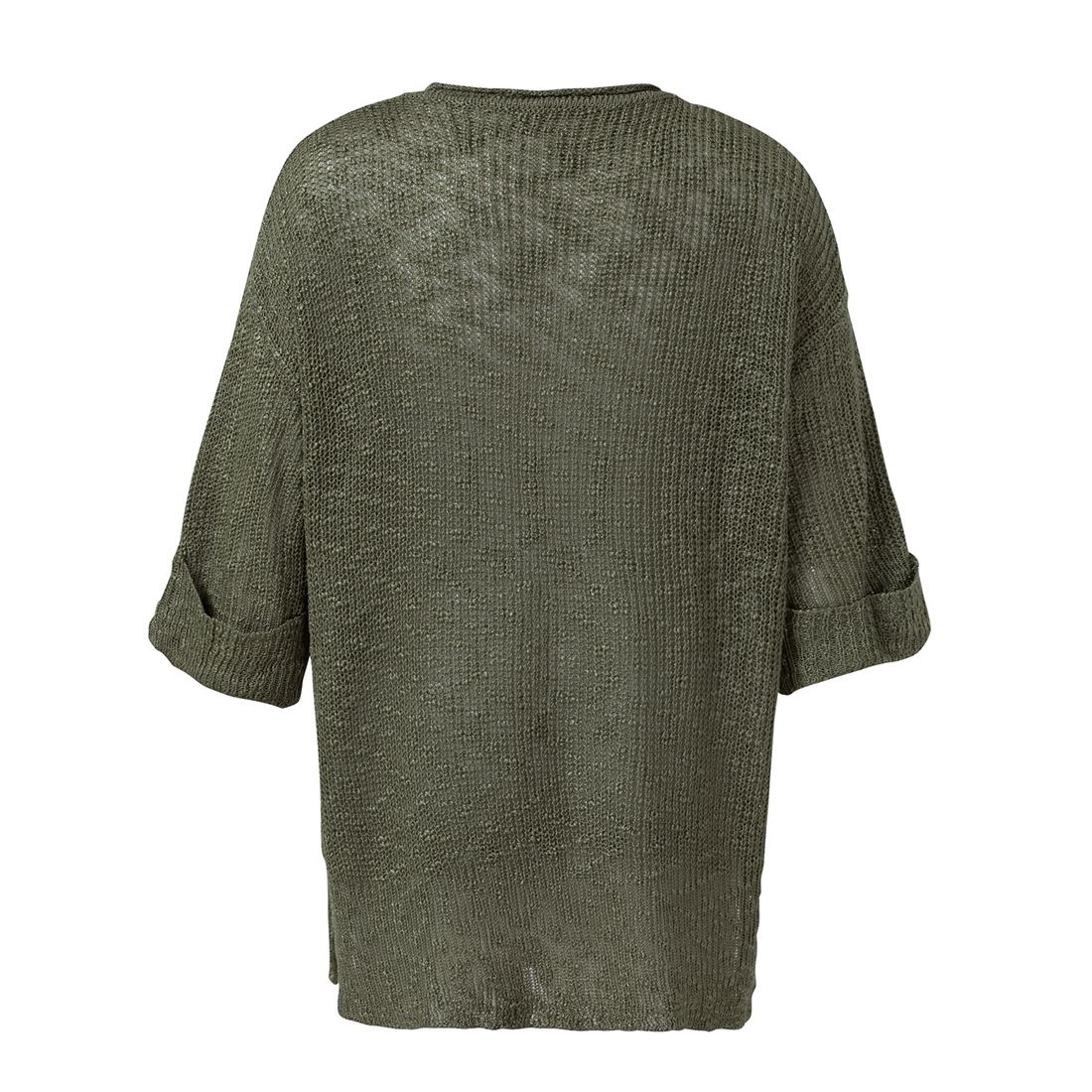
- The price is for the base version at a huge quantity. A "from $5.80" crewneck typically means plain stock design, stock yarn, and 500–1000 pieces per colour. Custom gauge, custom colourway, trims and smaller quantities all move it up — sometimes a lot. Our guide to reading a sweater quotation shows what a real, itemised quote should contain.
- The photos are rarely the seller's own. We regularly see the same model shots and flat-lays on dozens of unrelated listings, including some of our own product photography. Treat photos as decoration; ask for photos of their factory floor and their recent production.
- "100% cashmere" and "merino" claims are unverified. Fibre claims on listings are self-declared. If fibre content matters to your brand, it has to be backed by a test report on your actual order — see how cashmere adulteration actually gets caught in our article on cashmere authenticity testing.
- OEM, ODM and resale blur together. Many "manufacturers" on the marketplace are trading companies or shops reselling other factories' capacity. That's not automatically a problem — a good trading company can earn its margin — but you should know which one you're talking to, because it changes how you audit quality.
What the badges actually verify
"Verified Supplier" means a third-party inspection company visited the address and confirmed that a real, registered business operates there — legal existence, premises, production lines as claimed. That is genuinely useful and filters out a lot of pure fiction. What it does not mean:
- It is not a quality certification. Nobody audits whether your sweaters will pass lab testing or your inspection.
- It is not continuous. The check is periodic, not a live guarantee of who is on the machines this month.
- It doesn't cover sub-supply. Knitwear orders route through spinners, dyers, and sometimes linking workshops the badge never touched — the hidden-subcontracting question we cover in supplier vetting.
Trade Assurance, the platform's order-protection mechanism, is worth using for a first small order: it escrows the payment against shipping and specification milestones. Just read what it covers before relying on it for a complex custom program — its remedies are strongest on disputes about shipped goods and dates, weakest on subjective quality arguments.
From listing to real supplier
The buyers who succeed on the marketplace treat it as a recruitment funnel, not a shop:
- Shortlist five to ten, then verify. Cross-check the company name on China's business registry, ask for the business licence, and match it to the payment account name — the checks in our remote supplier verification guide take an afternoon and catch most fiction.
- Get on a video call. Ask to see the knitting floor live, not a recorded tour. A factory that can't show you machines today has a reason.
- Buy samples from two or three finalists. Not the listing sample — your style, in your yarn, per the sampling cost logic. The sample round is where marketing stops mattering.
- Compare quotation detail, not price. The supplier who itemises yarn, gauge, weight, trims, packing and lead time is telling you they can actually run the order.
When Alibaba is the wrong tool
Skip the marketplace entirely, or leave it early, when any of these apply:
- You need real development work. Fully fashioned knits with pattern engineering, grading and custom yarns are a collaboration, not a catalogue purchase — that's a direct-factory conversation from day one.
- Your MOQ is small and custom. Marketplace economics push suppliers toward volume on stock programs; specialised low-MOQ makers, like our low-MOQ knitwear arrangements, usually don't compete on listings at all.
- Certifications must be yours, not inherited. If your retail customer demands BSCI or Oeko-Tex scope covering your production, you verify scope directly with the factory — badges don't carry.
Worth knowing: many established Dongguan knitwear factories barely maintain their marketplace storefronts, because their order books come from referrals, trade shows, and buyers who found them directly. The best fit for your program may simply not be optimising for marketplace search. Casting a wider net — directories, fair follow-up per our trade show follow-up guide, and direct search — costs a few evenings and materially widens the pool.
At YZR Sweaters we work both ways: buyers who first find us through marketplaces, and buyers who come direct through this site. Either way, the conversation quickly moves to what matters — the tech pack, the sample, the quotation, and the inspection rights — and we keep those on email and WhatsApp (daniel@yzrsweaters.com / +86 137 2449 4230), not inside a storefront chat window. We're a Dongguan-based knitwear manufacturer with certified partner factories, and we'd rather show you the knitting floor on a video call than the badge on a listing.
Building a knitwear range and shortlisting factories? Send us your styles and target quantities — we'll quote properly, itemised, and you can benchmark us against anyone on your list.
Get a free quote Browse our knitwear rangeFrequently asked questions
Is Alibaba safe for buying sweaters in bulk?
Reasonably safe for shortlisting and first orders if you use the platform's protections and your own verification: company registry cross-check, video call, paid samples, and Trade Assurance on the first transaction. The risk is rarely outright scams — it's finding a trading company where you expected a factory, or accepting a listing price that doesn't survive your actual specification.
Does a Verified Supplier badge mean the knitwear quality is certified?
No. It means a third party confirmed the business exists at the stated address with roughly the stated operations. Quality is still governed by your tech pack, your sampling, and your inspection regime — the badge is a hygiene filter, not a quality system.
Why is the listing price so much lower than the quote I received?
Listing prices assume the plainest version of a style, stock yarn and colours, and large quantities per colourway. Custom gauge, custom-dyed yarn, branded trims and realistic MOQs all add cost — sometimes doubling the headline figure. A supplier who quotes you honestly above the listing price is usually more trustworthy than one who matches it and recovers the difference elsewhere.