
Knitwear Fabric Defects: Barre and Needle Lines
Quick answer
Knitwear has a category of defects that woven garments do not: faults in the fabric itself rather than in the making-up. Barre shows as horizontal bands of slightly different tone, needle lines run vertically as a single column of distorted stitches, sinker lines appear as a faint vertical streak, press-offs are holes where stitches were dropped, and oil marks are machine lubricant. Most are invisible on the sample and obvious in bulk, and the cheapest place to catch them is on the knitting floor rather than at final inspection.
A buyer inspecting a sweater looks at seams, trims and measurements. The defects that actually cause rework in a knitted garment are usually in the cloth itself, and they are easy to miss under showroom lighting and impossible to miss under a shop's own. Understanding what each one looks like, and which stage causes it, turns a vague complaint about "the fabric looks uneven" into something a factory can act on.
What is barre, and why is it so hard to see?
Barre — sometimes spelled barré — is a horizontal banding effect where the fabric reads as slightly lighter or darker across its width in regular bands. It comes from variation in the yarn or the knitting, not from dyeing, which is why a dyer can chase it for weeks without finding it.
The usual causes are inconsistent yarn tension, a yarn with uneven dye uptake, or mixed yarn lots knitted into the same panel. Because the bands are often only a shade apart, they disappear in diffuse showroom light and become obvious under the directional lighting of a shop or in daylight near a window. That is the pattern buyers should expect: invisible at approval, visible in retail.
The control is upstream. Yarn from a single lot, consistent tension across the machine, and a check on the first knitted panels rather than on the finished garment. Our notes on knitting tension explain how tension consistency is maintained and why it varies between machines.
What are needle lines and sinker lines?
Both are vertical artefacts caused by a single machine element behaving differently from its neighbours.
Needle lines. A damaged, worn or incorrectly set needle produces a continuous vertical column where the stitches are distorted — sometimes a visible ridge, sometimes a slightly different density. Because it runs the full length of the panel, it reads as a stripe on the finished sweater and cannot be pressed out.
Sinker lines. A faint vertical streak caused by a sinker — the element that holds the loop down while the needle rises — being worn or misaligned. Usually subtler than a needle line and often only visible against the light, which is why it is frequently missed at inspection.
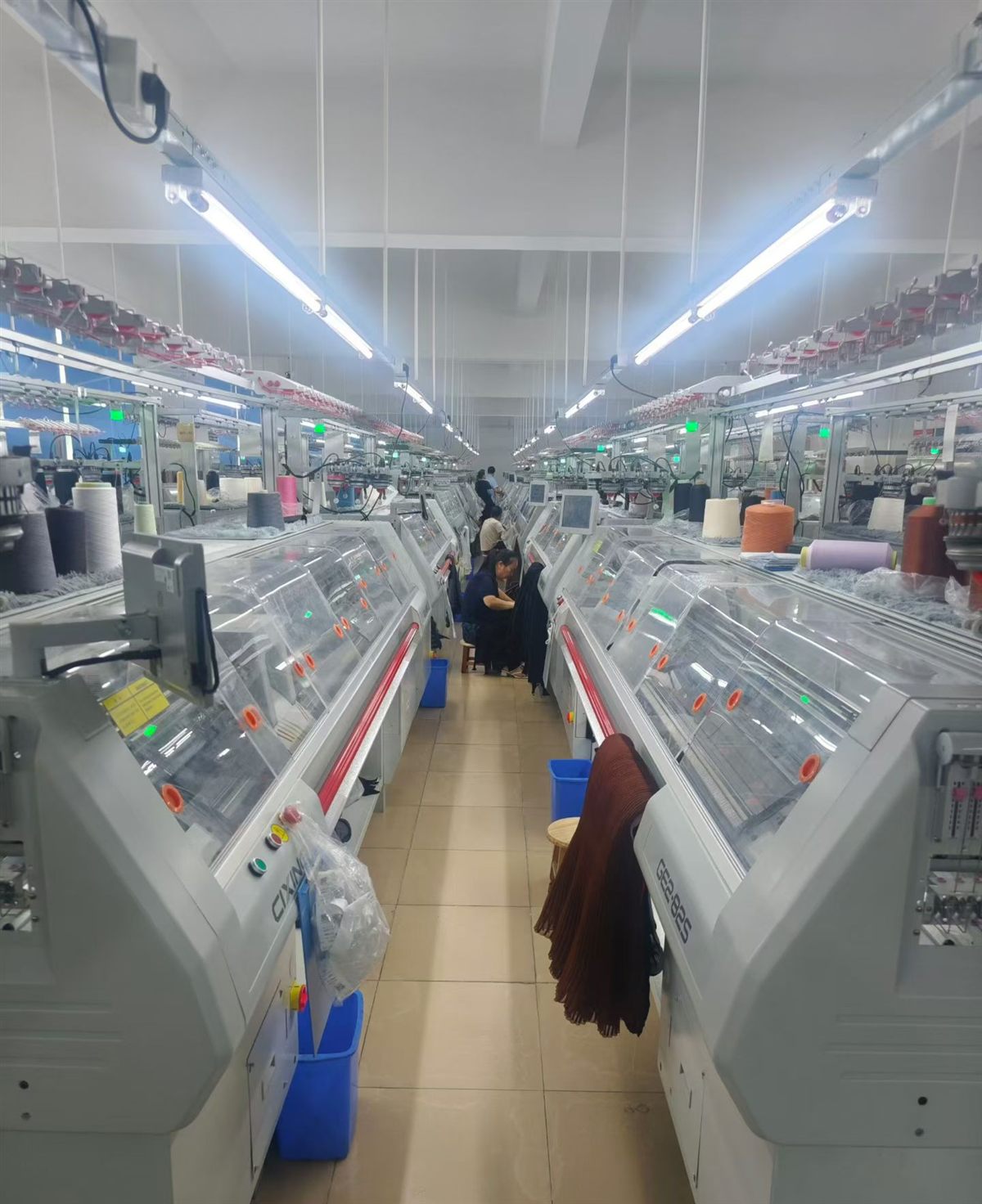
Both are machine-maintenance issues rather than yarn issues, and both are cheap to prevent and expensive to discover late. A factory that checks its needles and sinkers routinely does not produce these; one that does not will produce them consistently on a particular machine. Our notes on flat and circular knitting explain the machine types involved.
What is a press-off?
A press-off is a hole or a run in the fabric where stitches have come off the needles during knitting — the fabric "pressed off" and had to be restarted, or a small section was dropped and left. Depending on severity it is either a reknit or a mending job.
The sign to look for is a small area of distorted or repaired stitches, sometimes with a slightly different tension around it. Mending is legitimate and normal in knitwear, but the repair should be assessed against a standard: how many mend points per garment are acceptable, and how visible they may be. Our notes on common quality defects cover where mending sits in the defect categories.
The distinction that matters commercially is between mending that is invisible in wear and mending that shows. A garment with three well-executed mend points is not a defective garment; one with a visible repair on the chest is, regardless of how many points were allowed.
What about oil marks and contamination?
Knitting machines are oiled, and a machine that is over-lubricated or has a leak will mark the fabric. Oil marks typically appear as a faint dark smudge or a line along the fabric, and they may not become visible until the garment has been steamed or stored.
The related issue is contamination: fibres from a previous job, dust, or packaging material knitted into the fabric. A factory running pale colours after a black run needs to purge the machine, and a buyer ordering white after another customer's charcoal should ask whether that is done.
Both should be caught before finishing, because a mark found after pressing is usually too late. Our notes on dyeing and finishing explain why that stage is the last opportunity to remove or conceal a mark.
Which defects can still be fixed, and when?
- At the knitting machine: needle lines, sinker lines, press-offs and oil marks are all preventable and correctable. This is the cheapest window, and a factory that checks panels during knitting catches them here.
- At mending: a dropped stitch or small hole can be repaired, subject to the standard. A needle line running the full panel cannot be mended away — the panel is reknit.
- At finishing: some oil marks can be removed in washing. Shrinkage and pressing can change how a defect reads, which is why a defect approved before finishing may look different after.
- At final inspection: almost nothing can be fixed. The garment is either passed, mended or rejected, and the decision is expensive either way.
- After shipment: nothing can be fixed. This is where a claim begins.
Our notes on pre-shipment inspection explain what the final gate actually checks, and AQL sampling covers how a defect rate is judged against a limit.
How should a buyer specify against these defects?
- Name the defect categories in the quality standard rather than referring to "acceptable quality". Barre, needle lines, sinker lines, press-offs and oil marks are specific enough to be inspected for.
- State the lighting condition for inspection. Barre and sinker lines are only reliably visible under specified light — daylight or a defined illuminant — and an inspection done in the wrong light will miss them. Our notes on quality standards documents explain where that belongs.
- Set a mending allowance in points per garment and a visibility standard, so mending is defined rather than argued about.
- Require a first-panel check. A factory that measures and inspects the first knitted panel catches machine faults before they repeat across the order.
- Ask for the machine maintenance routine when vetting a supplier. Our notes on supplier vetting cover the questions worth asking.
At YZR Sweaters we work with partner factories holding BSCI, SEDEX and Oeko-Tex certifications, welcome factory audits, and support third-party inspection through firms such as SGS and BV. On fabric defects we agree the categories and the inspection lighting before production and check knitted panels during the run, because barre and needle lines are visible on the machine and effectively permanent on the finished sweater.
Setting a quality standard for knitwear and want the fabric defects defined properly? Send us your styles and inspection requirements and we will come back with what we can commit to.
Get a free quote Browse our knitwear rangeFrequently asked questions
Is barre a dyeing fault or a knitting fault?
Usually a yarn or knitting fault rather than a dyeing one, which is why dyers struggle to resolve it. It comes from uneven yarn tension, inconsistent dye uptake within a yarn lot, or yarns from different lots knitted into the same panel. The fix is upstream — single lot, consistent tension, and checking the first panels rather than the finished garment.
Can a needle line be repaired?
Not in a way that removes it. A needle line runs the full length of the knitted panel, so there is no discrete area to mend — the distortion is structural. The panel is reknit. This is why needle condition is a maintenance discipline rather than an inspection item: catching a worn needle early costs nothing, and catching the resulting line costs a panel.
How much mending is acceptable on a knitwear order?
There is no universal number, and a standard that says zero is not realistic. The workable approach is to set an allowance in mend points per garment plus a visibility standard — how noticeable a repair may be — and to state both in the quality document. Mending that is invisible in wear is normal production; a visible repair on a prominent area is a defect regardless of the point count.