
Sweater Necklines Explained: A Complete Buyer's Guide
 Views: 0
Quick answer
A sweater neckline decides which customer a style flatters, which season it sells into and how much craft it carries. Crew, V-neck, scoop, boat, square, henley, polo, mock, cowl and off-shoulder shapes cover most knitwear ranges, and each is defined by four numbers: opening depth, opening width, edge finish and whether it opens. Changing the neckline on one body pattern produces a different garment, so buyers should choose the shape deliberately and specify it in centimetres.
Neckline is the fastest way to turn one sweater body into several products — and the easiest place for a sample to go wrong. This guide lists the main neckline types, what each suits, and what buyers must state before knitting.
What makes up a sweater neckline?
A neckline is four parameters: opening depth, opening width, edge finish and whether the shape opens. Henley and polo styles add a buttoned placket; off-shoulder and asymmetric shapes add structure — a wide band, a strap or internal elastic — to hold the opening in place.
Opening depth and width
Depth is measured from the HPS (high point of shoulder) to the lowest point of the opening; width is the distance across it at the shoulder line. Deep and narrow exposes more chest; shallow and wide reaches toward the shoulder tips.
Neckline edge finish
Rib, rolled, bound or linked — the edge decides how a neckline behaves in wear. Ribbing is standard on crew and V necks because it recovers; a linked edge gives a flatter line; a rolled edge will not hold a deep V open. Edge stitch density is set by knit gauge.
Which sweater necklines should buyers know?
Ten shapes cover most ranges. Each entry gives the geometry, the customer it suits and the craft point to check.
- Crew neck — a round opening close to the base of the neck, and the most widely worn shape, suiting almost every face and body type across men's, women's and unisex ranges. Check it sits neither tight at the throat nor loose enough to slip a shoulder.
- V-neck — a pointed opening that lengthens the neck and slims the upper body, a menswear classic and a strong women's shape over shirts. Depth and angle change the whole look, so fix both in numbers.
- Scoop neck — a wide, deep rounded opening exposing the collarbone; a womenswear staple that reads soft. Confirm it stays compatible with bra straps and does not gape when the wearer bends forward.
- Boat neck / bateau — a wide, shallow opening running shoulder to shoulder in a straight line. Elegant on a relaxed body, but it widens the shoulder visually, so narrow frames carry it better.
- Square neck — a squared opening with defined corners, equally retro and contemporary. Strong in womenswear for how it frames the collarbone; the right-angle corners are the hard part to knit and link cleanly.
- Henley — a round or slightly V opening with a short button placket. Casual in tone, and it works in men's and women's ranges; the placket must sit flat.
- Polo collar — a folded collar over a short placket, drawing on sportswear and preppy codes. Collar crispness is the quality marker, so it needs a firmer, denser knit than the body.
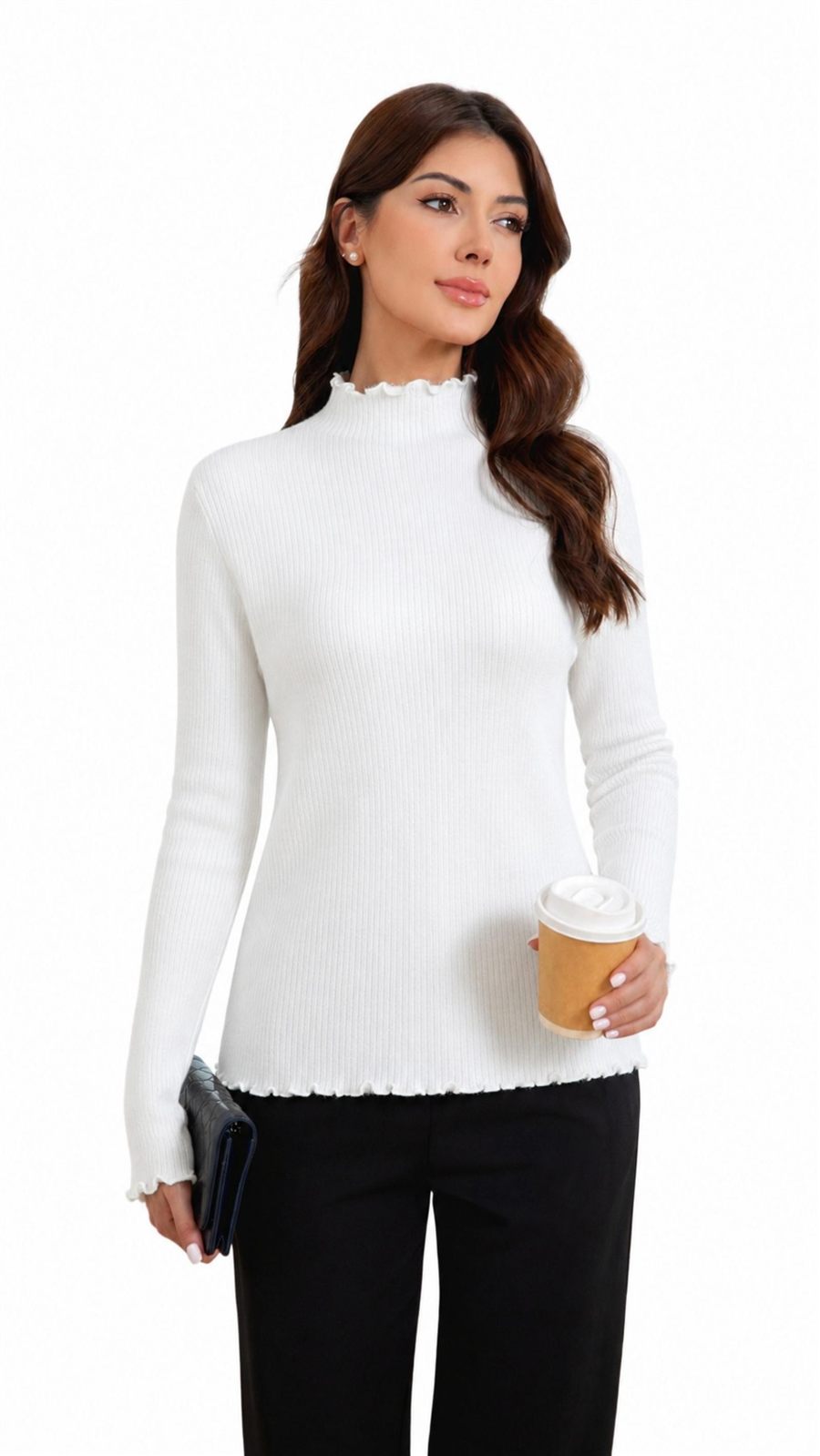
- High neck / mock neck — a close-fitting collar standing above the neckline; it carries cold-weather and layering ranges, and both throat fit and recovery after washing matter. Our guide to the turtleneck and mock neck covers collar height in detail.
- Cowl neck — an opening with extra fabric that collapses into soft folds. It needs a yarn with good drape and enough weight to fall rather than stand; a springy yarn gives a stiff, tube-like result instead.
- Asymmetrical / off-shoulder — an opening that sits off-centre or drops over one or both shoulders. Fashion-forward and photography-led, and prone to distortion, so internal support must be agreed at sampling.
How do neckline and body shape work together?
Match neckline to the silhouette it sits on. A wide boat neck reads calm on a relaxed body but looks stretched on a fitted one; a deep V opens up a longline shape. Crew suits relaxed bodies, V suits fitted, mock neck suits longline. The risk pairing is a wide, shallow neckline on a drop-shoulder body.
Does the neckline change cost and craft difficulty?
Yes, more than most buyers expect. The neckline is the most labour-intensive part of a sweater: the edge is knitted, then linked or sewn to the body, and the stitch count must match the body exactly or the edge ripples. Deep V and square shapes need the opening knitted to shape; cowls depend on yarn drape; polo collars need denser knitting.
Which neckline faults should buyers check on a sample?
Inspect every sample flat, on a hanger, on a body and after a wash test.
- Rippling or waving along the edge — the opening stitch count does not suit the body.
- Growth after washing — the rib is too shallow or the yarn lacks recovery.
- An uneven edge, thick on one side and thin on the other — usually a linking fault.
- Asymmetry — left and right do not match, visible on square shapes.
How should buyers write neckline requirements?
Put five things in writing: a reference sample; depth in centimetres from HPS; width across the opening; the edge finish named precisely (1x1 rib, 2x2 rib, linked, rolled or bound); and the recovery expectation. Prove it on washed goods through sampling.
Neckline development with YZR Sweaters
YZR Sweaters is a knitwear manufacturer and supplier in Dongguan, China, developing OEM/ODM sweaters, cardigans and knit tops for fashion brands, wholesalers and online retailers. We sample necklines as part of the garment, so you receive the style with edge finish, depth and width measured, plus a wash test on recovery. Our partner factories hold BSCI, SEDEX and Oeko-Tex certification, welcome audits, and support full inspection plus third-party inspection by SGS or BV, with MOQ flexible enough to test a neckline first.
Choosing a neckline for your next range? Send us the reference, target depth and width and quantity — we'll reply with a neckline option note, sampling plan and quote within one business day.
Get a free quote Visit yzrsweaters.comFrequently asked questions
Is a crew neck or a V-neck easier to sell in menswear?
Both sell, but they do different work. The crew neck is the safer base layer and the more common first order; the V-neck is the smarter option that shows a shirt collar underneath. Many menswear ranges carry both on the same body pattern, which spreads development cost over two styles.
Can a deep scoop neck be knitted in a heavy winter yarn?
It can be knitted, but it rarely works commercially. Heavy yarns have little drape and poor recovery, so a deep, wide opening tends to stand away from the body and distort. Scoop and other wide necklines are safer in fine and mid-gauge yarns where the edge can be ribbed tightly enough to hold its shape.
Why does my sample's neckline ripple when the rest of the garment fits well?
Rippling is almost always a stitch-count problem at the opening rather than a body-fit problem. The edge has either too many stitches for the circumference it must follow, or too few for the elasticity of the yarn. Ask the factory to re-calculate the neckline stitch count and re-link the edge, then check the result on a washed sample.
Comments
Comments are loading. To enable live comments, see setup notes in the repo.