
Hand-Crochet Knitwear Sourcing: A Buyer's Guide
Quick answer
Crochet is handwork. No flat or circular knitting machine produces a granny square, so crochet orders are made by piece-rate workers, and your price, lead time and quality plan all follow that fact. Budget a third to half more time than a machine-knit equivalent, expect tension variation between workers unless you manage it, and design the order so it can be split across a team without visible seams between workers' hands.
We get crochet enquiries every spring — a brand sees granny square cardigans and mesh tops all over Instagram and wants "the same thing, 3,000 pieces, in eight weeks." Some of those orders work beautifully. Others we talk the customer out of, because what they actually want is a machine-knit imitation of crochet, and that is a different product. This guide is the conversation we end up having every time, written down.
Crochet is not knitting — and that changes everything
The two crafts look related on a rail but behave completely differently in production. Machine knitting forms loops across needles; crochet is built one stitch at a time with a single hook, which is why the fabric is denser, more textured, and full of openwork that machines simply cannot form. There are crochet-type machines, but they cover a narrow slice of the stitch vocabulary — a granny square, a mesh halter or a shell-stitch top has no machine equivalent worth the name.
What that means commercially: your crochet order is hand-made whether you like it or not. It is produced by crocheters working to a piece rate, usually organised in small teams around a workshop that supplies yarn, charts and finished-garment checking. Capacity is people, not machines. When we plan a crochet programme we are effectively booking hands, and the rules of capacity planning apply with a human dimension added — crocheters have seasons, harvest holidays in their home villages, and opinions about stitch counts.
What buyers actually order
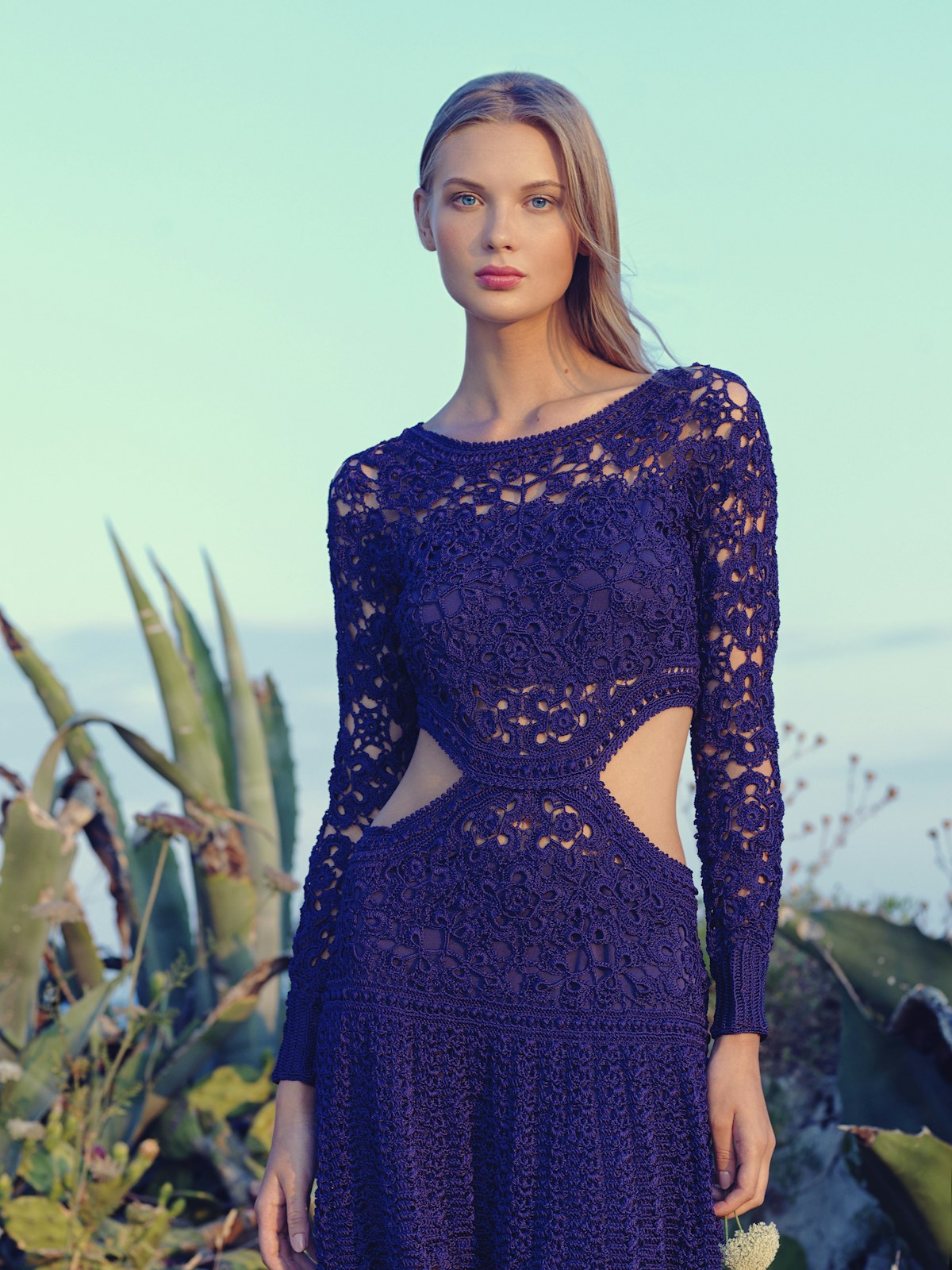
- Granny square garments. Cardigans, vests and tops assembled from crocheted motifs. The look of the season for several seasons running. Each square is a unit of work, which makes costing and QC refreshingly modular.
- Mesh and openwork tops. Halter necks, long-sleeve mesh layers, swim cover-ups. Light on yarn, heavy on labour — the stitches are the product.
- Crochet bags and hats. The strongest accessory story in the category; see our general knit accessories guide for how accessory programmes differ from garment ones.
- Crochet trim and panels on machine-knit bodies. The compromise many brands land on: machine-knit the body in cotton, hand-crochet the borders, sleeves or motif inserts. You keep machine economics for 80% of the garment and buy the hand look where it shows.
Yarns: what works in a hook
Crochet dominates spring and summer programmes because the open fabric suits warm weather, and that means cotton does most of the work. Combed cotton, cotton-acrylic and cotton-linen blends all crochet cleanly and hold a motif's shape through washing. Slippery or fragile yarns — fine silk, single-ply wool — are harder: a crochet hook stresses the yarn at every stitch in a way needles do not, so we steer buyers towards plied, elastic yarns for anything structural. Fancy fancy yarns with slubs or loops can be crocheted, but expect slower work and more second-quality; test before committing a whole colour story to them.
Expect to use more yarn than a knit equivalent of the same weight feels like it should take — crochet stitches consume measurably more yarn per square centimetre than knit stitches. If you are budgeting yarn yourself, the approach in our yarn consumption guide needs a generous uplift for crochet, and motif-based designs let you weigh one finished square and multiply instead of estimating.
Costing and lead times, honestly
A crochet quotation is built from three numbers: yarn, piece-rate labour, and finishing. The piece rate scales with stitch density — a fine-gauge mesh top in 2.5mm cotton can take as long as a heavy aran cardigan takes to knit. When you compare suppliers' crochet prices, make sure they quoted the same yarn weight and the same stitch; a "cheaper" quote usually means a bigger hook and a looser fabric, and that difference is visible on the rail.
On timing, we quote hand crochet at roughly 1.3 to 1.5 times the lead time of a comparable machine-knit programme, and we hold back a buffer for re-crocheting pieces that fail checking. If a supplier quotes machine-knit lead times for full hand crochet at volume, that is not efficiency — that is a plan to subcontract somewhere you have not audited, which is the risk pattern we describe in our unauthorized subcontracting guide.
The quality problem unique to handwork: tension
Every crocheter's hands produce a slightly different tension — the same hook, the same yarn, and one woman's motif comes out a centimetre bigger than her neighbour's. Left alone, this shows up as squares that will not align, ragged panel joins, and garments that pass measurement on average but not on inspection. We see this a lot, and it is manageable, but only if you plan for it:
- One crocheter per garment where the design allows. A single-worker cardigan has uniform tension by definition. For 500 pieces this is how you should build the order.
- Blocked motif standards. For granny square programmes at volume, the workshop keeps a blocked reference square for each colourway; every crocheter's first batch is measured against it before her yarn allowance is released. This is the single most effective control in hand crochet.
- In-line checking, not end-of-line only. Our inline inspection approach matters more for handwork than machine work, because a tension drift caught at 20% costs a re-crochet of a panel, and caught at 100% costs the order.
- Sampling that reflects the team. Approve the sample knowing it was made by your supplier's best crocheter, then ask for a small pilot batch made across several hands before bulk approval. The gap between the two is the gap you will live with in production.
What your tech pack needs for crochet
A knitwear tech pack can lean on gauge and machine settings; a crochet tech pack cannot, because there is no machine to set. Ours asks buyers for: a stitch chart or reference garment (crocheters work from diagrams and physical samples, not verbal descriptions), finished dimensions per motif and per garment, a target finished weight, yarn specification, and join/finishing rules — where seams sit, how motifs are attached, and what the inside should look like. Weight per garment is the quiet hero: it is the only number that catches both yarn substitution and loose tension without anyone having to count stitches.
If you only have a photo from Instagram, that is still a start — a good supplier can reverse-engineer stitch, motif and construction from photographs and a target retail price, then send you physical swatches to lock the specification. But budget for that development loop as a real sampling stage with paid samples, not a formality.
Where YZR Sweaters fits
We are a Dongguan knitwear factory producing both machine-knit and hand-crochet programmes for fashion brands and wholesalers. Crochet orders run through our workshop network with blocked motif standards, per-garment weighing and inline checking built into the process; machine-knit components — trims, bodies, finishing — stay in-house. Send us your reference images or stitch charts, and we will tell you honestly which parts should be crocheted, which parts should be knitted, and what that means for price and calendar.
Planning a crochet programme for next season? Send us your references and quantities — we'll come back with a stitch plan, a sampling calendar and an honest quote.
Get a free quote Browse our knitwear rangeOr reach us directly: daniel@yzrsweaters.com · WhatsApp +86 137 2449 4230 · Dongguan, China
Frequently asked questions
Can't crochet be done by machine to save cost?
Only partially. Some simple chain and mesh structures can be approximated on warp knitting machines, and there are single-chain crochet machines used for trim and elastic. But the stitches that define the look buyers want — granny squares, shells, fans, dense textured fabric — have no practical machine equivalent. If a supplier offers you "machine crochet" at half the hand-crochet price, ask for a physical sample and compare it stitch by stitch against your reference; usually the fabric, drape and motif geometry are visibly different products.
What MOQ should I expect for hand crochet?
Hand crochet is one of the few categories where low order quantities are genuinely workable, because there is no machine set-up to amortise — a supplier organising twenty crocheters can run 200 pieces as efficiently as 2,000, and the low-MOQ economics look better than in machine knitting. The constraint runs the other way at high volume: a 20,000-piece crochet order is a staffing project, not a production slot, so bring it to your supplier early.
How do I check crochet quality without knowing how to crochet?
Use the three checks that need no craft knowledge: weigh the garment against the approved sample's weight, measure each finished motif against the motif spec, and lay the garment flat under even light to look for visible tension banding or wavy seams between sections. Then wash one sample per crocheter's batch if the programme is split — tension problems that hide on a dry rail often reveal themselves after washing, which is the logic behind our general sample wash test.