
Sourcing Spring/Summer Knitwear: Lightweight Sweaters, Dresses and Tanks
Quick answer
Spring/summer knitwear is its own product category, not just "thinner sweaters". It runs on fine gauges (12GG–16GG), breathable yarns like cotton, viscose and linen blends, and styles built for heat — knit dresses, tanks, polos and open-work patterns. The sourcing logic differs too: lead times are shorter, MOQs are often lower because factories fill off-peak capacity, and colour is doing most of the selling.
Buyers who know us for winter sweaters are sometimes surprised that a good part of our production calendar is spring and summer work. It shouldn't be surprising — knitwear factories in Dongguan run all year, and the buyers who use the off-peak months well get better prices, faster sampling and more attention than the ones who only appear in the autumn rush. Here's how the warm-weather category actually works.
The styles that carry a summer knit range
Summer knitwear sells on silhouette and colour more than on warmth, and the categories behave differently:
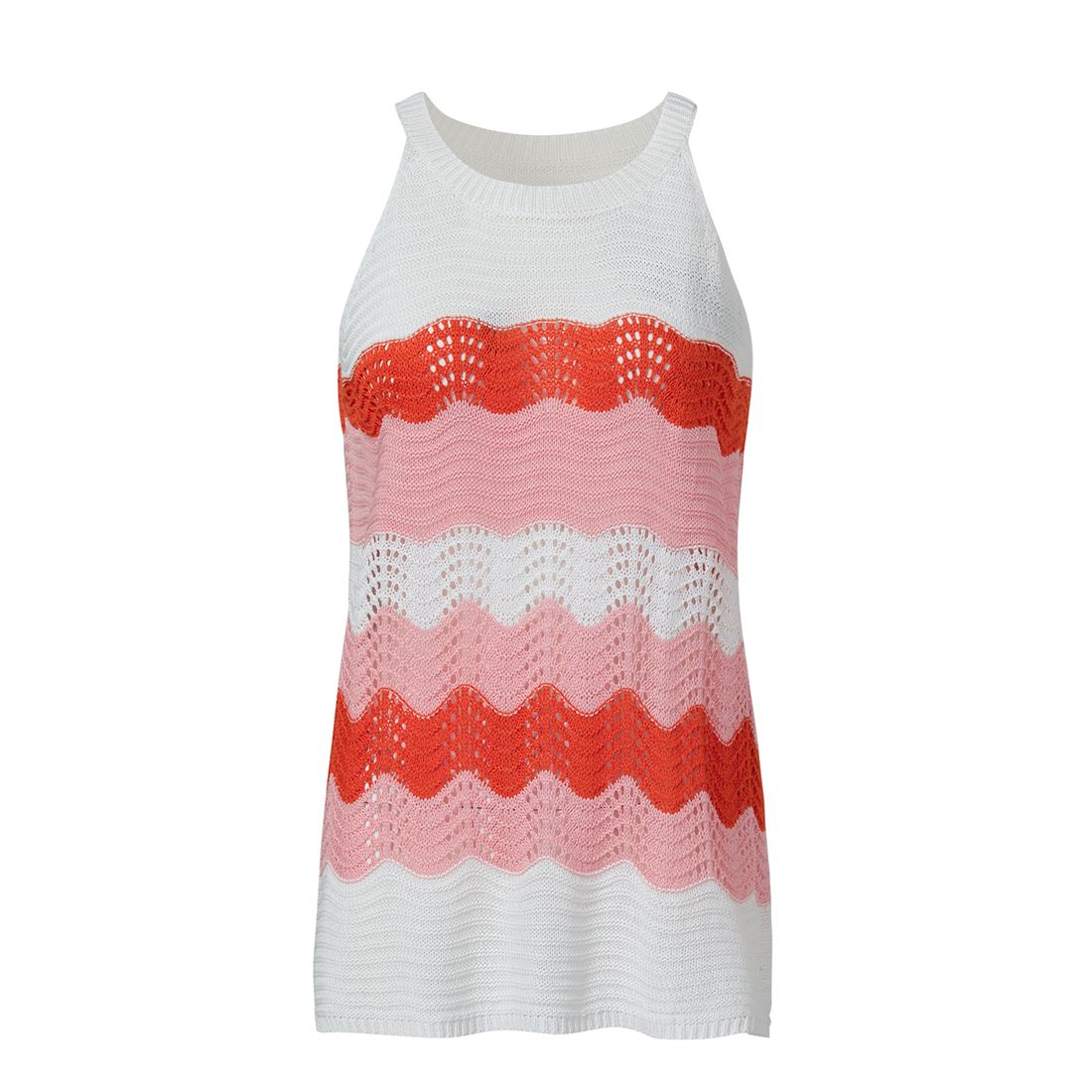
- Knitted dresses are the strongest summer knit category we produce — halter necklines, wave stripes and pointelle open-work all photograph well and pack small for e-commerce. The coral wave-stripe halter dress and its sky blue sister style are current examples from our own lines: sleeveless, breathable, and bold enough to anchor a capsule on their own. Our knitted dress buying guide covers opacity and sizing risk in detail.
- Knit tanks and vests ride the same wave — literally, in the case of wavy-stripe jacquards. Low fabric weight, low price point, strong colour story.
- Fine-gauge polos are the year-round backbone of the category for menswear. Our knitted polo wholesale guide goes deeper on gauge and collar construction.
- Lightweight cardigans and shrugs sell as air-conditioning and evening layers — a real use case in most markets, and a good excuse for a second colourway of a dress.
Yarn is where summer knitwear is won or lost
Get the yarn wrong and no styling saves the garment: a summer knit that feels warm is a return with your name on it. The working palette:
- Cotton — the default. Breathable, washable, familiar to customers, and available in every colour at low minimums. Its weakness is weight and drape on longer styles; our cotton sourcing guide covers blends that fix that.
- Viscose and viscose blends — cooler hand feel and a fluid drape that suits dresses. Watch colour fastness on deep shades and wet strength in washing.
- Linen blends — the premium summer story, usually blended with cotton to tame the creasing. Excellent for resort capsules at a higher price point.
- Fine acrylic and acrylic blends — the budget option; fine for fashion-driven pieces where hand feel is less critical, but be honest with yourself about breathability in genuine heat.
Whatever you choose, specify the gauge with it. Most summer styles live at 12GG–16GG; our gauge explainer translates those numbers into fabric weight and feel if you're writing the spec yourself.
Why off-peak timing is the real opportunity
Knitwear factories fill their machines with winter bulk from roughly June to October. The months on either side are when summer sampling is fastest, yarn suppliers are most flexible on small dye lots, and a 200-piece order gets answered the same day instead of queued behind a 20,000-piece program. If you sell in the southern hemisphere, this flips — our reverse-season buying guide maps that calendar — but the principle holds: order against the crowd.
For northern hemisphere spring delivery, briefs in October–November, samples before Christmas, and bulk shipping in January–February is the comfortable rhythm. Our buying calendar has the month-by-month version.
The mistakes we see every spring
Three, mostly. First, translating a winter bestseller into "the summer version" by just lowering the gauge — the proportions, drape and opacity all change, so treat it as a new style and sample it properly. Second, choosing colours by winter logic: summer knitwear lives on fresh, high-chroma colour, and that means lab dips matter more, not less — see our notes on colour approval. Third, skipping the wash test because the garment is lightweight; fine viscose knits are exactly where shrinkage and spirality show up. The sample wash-test protocol takes an afternoon and is non-negotiable for summer styles.
We run spring/summer development alongside our winter program at our partner factories in Dongguan — same BSCI/SEDEX/Oeko-Tex certified production, same sampling team, but with the off-peak advantage on timing and MOQ. If you're planning a warm-weather capsule, it's one of the friendliest first orders to start a supplier relationship with.
Planning a spring or summer knit range? Send us the styles you're thinking about — dresses, tanks, polos or something else — and we'll suggest yarns and give you a sampling timeline that hits your launch.
Get a free quote Browse our knitwear rangeFrequently asked questions
What yarn is best for summer knitwear?
Cotton is the default — breathable, washable and available in every colour at low minimums. Viscose blends give a cooler hand feel and better drape for dresses, linen blends suit premium resort capsules, and fine acrylics work for budget fashion pieces. Match the yarn to a fine gauge, usually 12GG to 16GG.
When should I place a spring/summer knitwear order?
For northern hemisphere spring delivery: brief in October–November, approve samples before Christmas, and ship bulk in January–February. These months are off-peak for knitwear factories, which means faster sampling and more flexibility on small orders than the autumn rush.
Do summer knit styles have lower MOQs?
Often, yes — summer production falls in the factories' quieter months, so small runs are easier to accommodate. Fine-gauge styles also knit faster, which helps. The honest answer still depends on the yarn: a custom-dyed colour carries its own minimum regardless of season, so stock yarns are your friend on a first summer order.